Ah, postcards. The travel microblogs of yore. For decades they were the preferred (if not only) method for sending updates and short messages from near and far to friends and family. If you ever find yourself bored in an antique store, head over to the postcard section (usually stuffed in a shoebox) and spend some time reading the messages scribbled on them. My favorite message to date was sent from Lutsen, MN and read, simply, “At last I have found a slot machine. I shall postpone my return.”
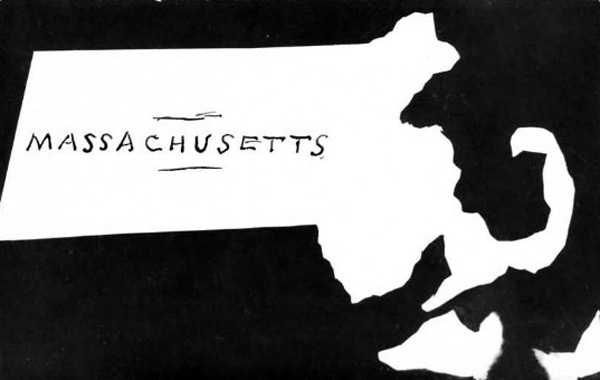
The messages on the backs of old postcards vary wildly. And thankfully for us, so do the images on their fronts. Here, I’ve compiled a small collection of Massachusetts map postcards. You will notice that the only thing that ties many of these postcards together thematically is that they depict space. The way space is being represented (or, er, distorted) depends on the purpose of the card. Above is what is called a real photo postcard. Technically, postcards of this kind still exist (as long as it is a postcard made from a real photo, right?). But in the eyes of a collector, this type of card is generally from 1890s – 1930s. The scratched out negative map of Massachusetts above, which I found on eBay, represents the only real photo map postcard I have ever seen. It’s not a bad likeness either, if you ask me.
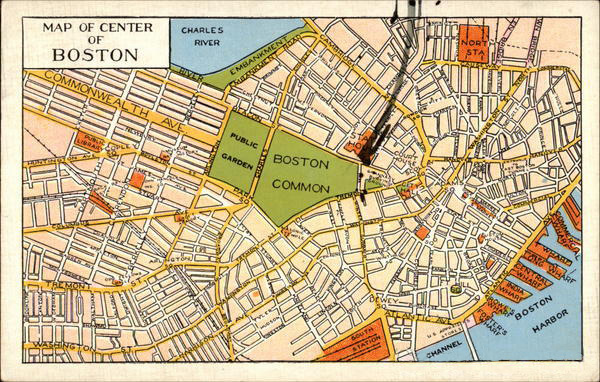
The most straight-up map postcard you will see would be something like this “Map of Center of Boston.” It is basically a reference map for walking, or possibly even driving. Postcards of this type were reasonably commonplace (especially when branded for promotional purposes) throughout the 20th century. But I wonder when people were supposed to use this map of the “center” of Boston. Perhaps it was meant to be employed as a reference until no longer needed, and then sent. Or, it could have been sent ahead to a future tourist who would be visiting the city soon. Upon his visit, that tourist would likely then encounter a number of other postcard maps designed specifically for him (e.g., he would probably run into postcards of historic subject matter such as Paul Revere’s Ride and The Freedom Trail).
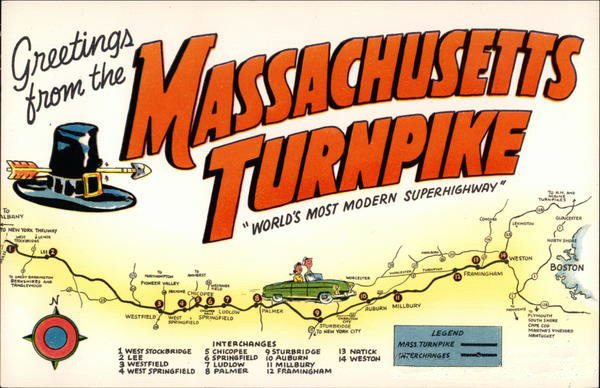
Here’s another kind of postcard map. This one promotes the Massachusetts Turnpike as the “World’s Most Modern Superhighway.” Ha. I must say, I like a few things about this postcard. First, you have to love any design that is adorned with a battle-torn, anachronistically buckled pilgrim hat. I mean, didn’t we all learn that Pilgrims didn’t wear buckled hats on our 2nd-grade field trips to Plymouth Rock? Second, the card implies that the greetings are coming directly from the highway (written whilst driving, in fact). So I have to ask: Who wants to be greeted from a highway? Perhaps that is also a thing of yore. Finally, as an extension of my second point, another question: Who likes a highway enough to buy a postcard of it? I mean, I know that turnpikes were new and hip and everyplace likes to tout their transportation infrastructure as supreme, but… um… I’d rather get a postcard of the Union Oyster House or something.
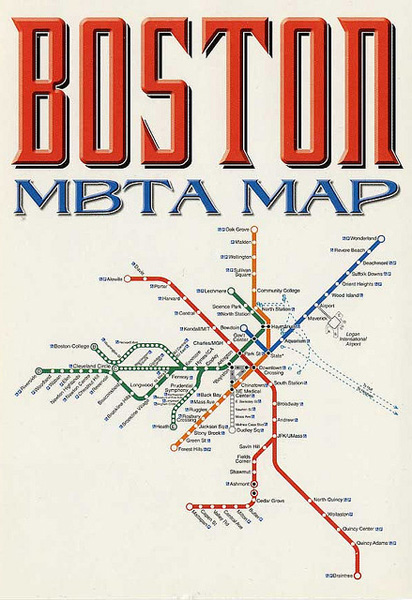
Speaking of transportation infrastructure, here is a postcard of the Boston T system (another gem from Cartophilia). Andy and I have had quite a lot of back-and-forth about the date of this map. Tricked by typographic design (and subtle yellowing), we both initially assumed it was from the 60s or 70s. But after a bit of research, Andy believes it is likely from the last 10 years (N.B. look forward to a future post on the changing style of Boston T maps over the years). This, like the map of downtown Boston, could be used as a reference for T riders, but the degree to which the design is reminiscent of Harry Beck’s famous London Underground map leads me to believe that it was likely sold equally as an art postcard.
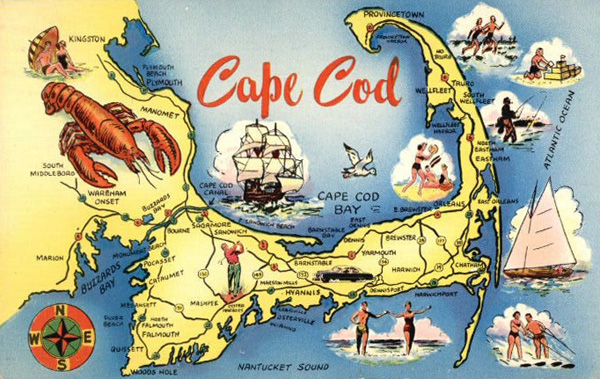
With this card, we move on from postcards with potential artistic appeal to those with indistinct artistic appeal. Here we have a fairly common type of map postcard. I might call this an “arbitrarily proportional symbol” tourist map, where the variable is “fun.” Because, let’s face it, what’s more fun than lobster? Sailboats, waterskiing and compass-rosing appear to be reasonably fun. But it’s fairly clear that tall-shipping is the second-most-fun thing to do on the Cape. Cartoon-style and automobile-themed postcard maps of the Cape were fashionable throughout the 20th century.
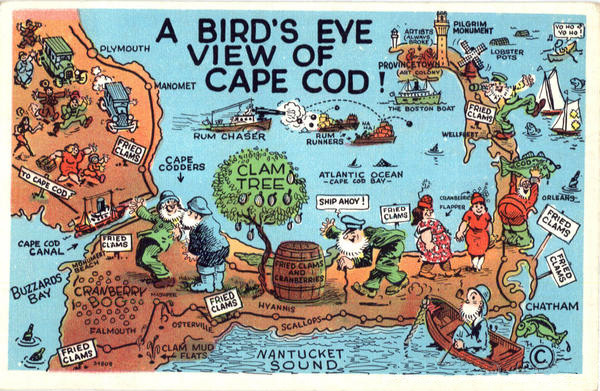 According to this map postcard, fried clams are notably more fun than lobster. This card comes from an era when lampooning was the norm (exaggeration was also the norm, as in this postcard of a Maine potato). While most of the postcards we see on the racks these days are picturesque aerial views or scenic shots of monumental architecture, this card comes from an era when making things look significantly worse than reality somehow attracted tourists. (N.B. P-town as an “Art Colony” inhabited by “always broke” artists).
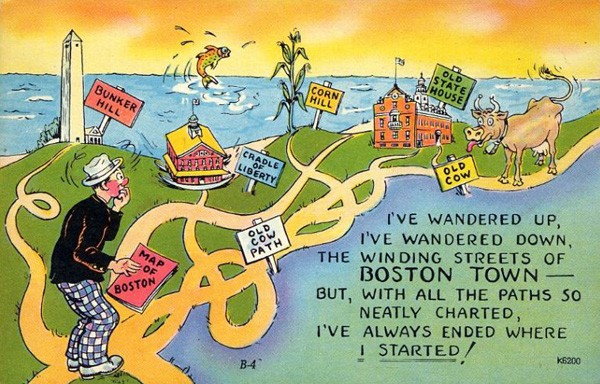
I would also file this postcard under “things portrayed worse than reality.” This style of postcard with bright yellows and oranges, saturated greens, rosy faces and grossly caricatured animals (like the cow and fish here) was common from the 1930s-1950s. They are often printed on card stock that resembles linen in texture (in fact, most postcards from this era are referred to as linens). This type and style of postcard often gets a lot of attention because some cards tend to be quite risqué.
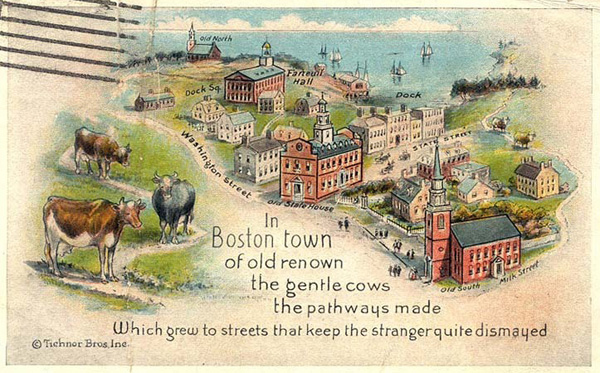
The topic of this postcard and the linen one above it (the confusion of navigating Boston) is one that lives on today. But faulting wandering cows for meandering urban design is now known to be misplaced blame. The truth is a shame though, because the myth was clearly fodder for some choice cards in the early 20th century. Either way, it seems to me that given the rate at which the extent of buildable land was increasing in the 1800s, it’s no wonder Boston’s streets aren’t strictly gridded.
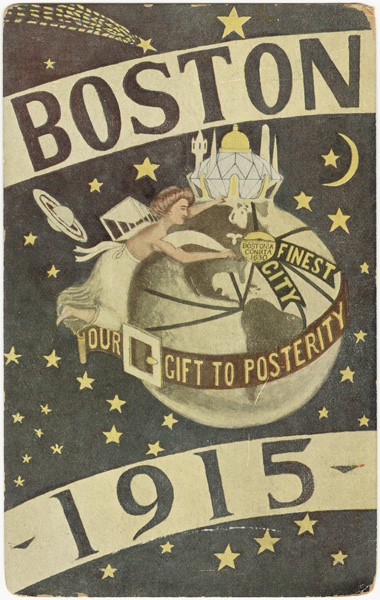
For fear of this post getting a bit long, I’ll end with this card (from the BPL). It’s hardly a map of Massachusetts, I know. But it is definitely a map (and Boston is labeled on it), so I had to include it. Plus, how could I not include this postcard? I mean, just look at it. I have to say, without knowing what was going on in 1915, this card is a bit difficult to decipher (difficult-to-decipher cards were definitely a thing in the early 1900s—or at least, they are difficult to decipher by the standards of a 2010s blogger). It clearly states that Boston is the “Finest City” in the… er, world. But of the majority of the card’s design remains incomprehensible to me. For example, who is this person and what is she doing with a cage on her back? What’s that diamond city in the north? And, lastly, why is the earth wearing a belt (without any pants)?
16 Responses to (Cartographic) Greetings from Boston